
Configuration Space
Prerequisites: Newtonian Mechanics. Full path (5 pages)
see also Phase space and Hilbert Space
Intuitive
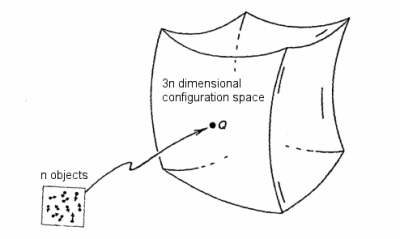
adapted from page 174ff in “The Emperors new Mind” by R. Penrose
The configuration space or configuration manifold is the collection of all the possible "snapshots" or descriptions that the system can take.
Formulated differently, the configuration space is the possible "positions" of a mechanical system. Take note that the states of motion, eg. velocities/momenta are not part of the configuration space. This is in contrast to the phase space, where we also take the states of motion into account.
The state of a system is recorded in a configuration space point through all the locations that the objects in the system have at a given point in time.
The time evolution of a system can then be represented as a path in configuration space.
Concrete
Each point of the configuration space represents one configuration our system can be in. For example, each specific way a double pendulum can be arranged is a point in our configuration space. The total configuration space consists of all possible configurations.
The simplest example is an object moving in just one dimension. The configuration space is just a line, i.e. . Now, if we want to describe two objects which move in one dimension, we have two choices. Either we describe them using two location vectors:
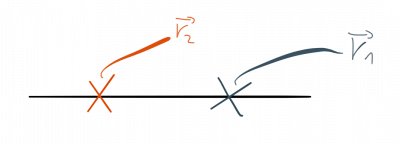
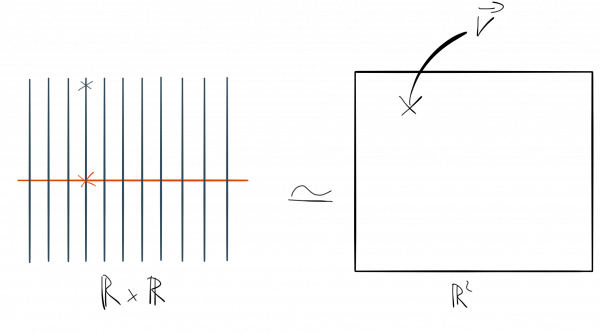
or we glue the configuration spaces of the two objects together to one big configuration space and then only keep track of one location in this total configuration space:
When we glue two lines together we get a rectangle. At each possible location of the first object, we need to take into account the possibility that the second object could be anywhere. Hence we need a complete copy of at each location of . Gluing a copy of to each point of yields a rectangle. Such a construction is known as a product space.
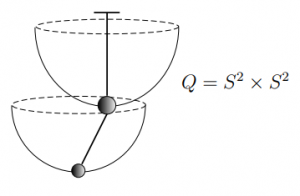
Configuration space of a double pendulum. Source
Another good example is the pendulum. The total configuration space of a pendulum swinging just in two dimensions is a circle , since a pendulum can swing once around its suspension. The configuration space of a pendulum swinging in 3-dimensions is the sphere .
This is useful, since now we can describe our system in terms of paths in the configuration space. The system starts in one specific configuration, which corresponds to one point in the configuration space. Then as it evolves this point starts moving around in configuration space. Thus, we only need to keep track of how this one point moves around.
In contrast, for example, for a double pendulum in the traditional language we would need to keep track of the exact positions of the two pendulums.
No matter how many particles or objects there are in our system, each specific configuration is exactly one point in our configuration space.
Any set of parameters which can characterize the position of a mechanical system may be chosen as a suitable set of coordinates. They are called the "generalized coordinates" of the system and are the coordinates of the configuration manifold.
Further Examples
Free Particle
Free Particle on Space : it can be a 3 dimensional manifold, in fact, , and the coordinates can be multiple: Cartesian, spherical, cylindrical coordinates.
Multiple Free Particles
For 3 non-interacting point particles moving through space the configuration space is
Each point in this space corresponds to one specific configuration of our 3 particle system.
The 3 particles trace out continuous trajectories through , but the whole system can be said to trace out a continuous path through . So instead of three trajectories through we now only have to track one trajectory through .
Rolling Sphere
Rolling Sphere on a Plane : the position of contact of the sphere on the plane, and as the possible orientations of the sphere, so the configuration space is
Electromagnetism
For Electromagnetism , the thing is more triky, as the configuration space are not positions, but measures of the values of different fields over all space-time. The true coordinates of the fields could be the 4-potential , so the configurations are 4 vector functions of 4 variables: So
References
- [Lanczos, C.] Principles of Classical Mechanics
- [Sussman G. J., Wisdom J. & Mayer M. E. ]Structure and Interpretation of Classical Mechanics
- No-Nonsense Classical Mechanics by Jakob Schwichtenberg, section "Mathematical Arenas"
Abstract
As the name indicates, the mathematical figure is a manifold, and we will denote it as . We will use the letter to denote the points of the system, and will denote the coordinates. The link between both is called configuration map
The tangent bundle TQ will be referred to as configuration space, later on when we get to the chapter on Hamiltonian mechanics we’ll find a use for the cotangent bundle , and normally we call this the phase space.Lectures on Classical Mechanics, by John Baez
Why is it interesting?
In the Lagrangian formalism, we describe what happens in classical mechanics by referring to points in the configuration space. In this sense, the configuration space is for the Lagrangian formalism, what the phase space is for the Hamiltonian formalism.
Configuration spaces are also the central objects in robotics, as the set of reachable positions by a robot.
Path to this page
Leads to: Phase Space.