
Pendulum
Prerequisites: Harmonic Oscillator, Lagrangian Formalism. Full path (11 pages)
Intuitive
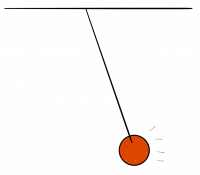
A pendulum consists of a freely hanging massive bob at the end of a rod. When we move the bob a little to one side it starts swinging.
We usually describe it by measuring how far the bob has moved from its original position where it just hangs freely. How the pendulum swings depends crucially on the length of the rod and the strength of the gravitational field. A pendulum on the moon swings differently than a pendulum on earth.
An important observation is that the swinging of the pendulum does not depend on the mass of the bob.
A pendulum is right after a harmonic oscillator the simplest physical system we can study. In fact, if the pendulum only swings a little it is a harmonic oscillator. The difference between the harmonic oscillator and the pendulum only become important for large swings.
- see also the nice interactive demonstration here.
Concrete
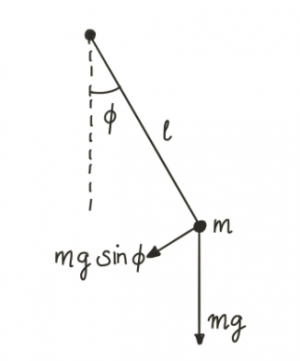
A normal pendulum hangs freely in a uniform gravitational field of strength on a rod with length . The excitation above the ground state is measured by the angle . At the end of the pendulum, we have a bob of mass . This is shown in the picture on the right-hand side.
The tension of the rod acts perpendicular to the path of the bob, so the only force along the path is the tangential component of the gravitational force, . Therefore, using Newton's second law the correct equation of motion for the pendulum is
Now we need to get rid of the arc length on the left-hand side using . This yields
It is important to note that we can remove mass from the equation because it appears on both sides:
The swinging of the pendulum, therefore, does not depend on the mass of the bob.
Small Angle Approximation
The equation of motion of the pendulum is a non-linear equation which is hard to solve. However we can simplify it for the case when only small swings are happening. Then we can use the small angle approximation .
This yields the equation which can be solved to give the familiar equation for the harmonic oscillator where is the amplitude and is the constant phase offset.
The Pendulum in the Lagrangian Formalism
The kinetic energy of the pendulum is
and the potential energy in the gravitational field of the earth
The Lagrangian of the pendulum is therefore
where denotes the time derivative.
Using the Euler-Lagrange equation we can derive the corresponding equation of motion
- For a nice complete discussion, see The Pendulum: A Case Study in Physics by Gregory L. Baker and James A. Blackburn
- No-Nonsense Classical Mechanics by Jakob Schwichtenberg, chapter "The Pendulum"
Abstract
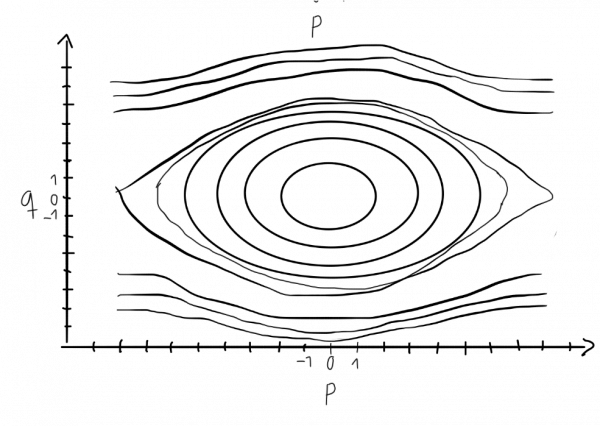
The configuration space of the pendulum is the circle , so the phase space is the cotangent bundle , a cylinder with coordinates , , and symplectic form . The Hamiltonian is With one degree of freedom and conserved, the system is integrable, and the phase portrait consists of the level sets of .
Structure of the phase portrait. Write . There are two equilibria: , a center (stable, hanging down), and , a saddle (unstable, standing up). For the orbits are closed curves around the center (librations), contractible on the cylinder. For they wind around the cylinder (rotations). The two regions are separated by the separatrix , which consists of the saddle and two orbits that approach it asymptotically as . On the upper branch, which needs infinite time to go from to .
Exact period. For a libration with amplitude , energy conservation gives the period with the complete elliptic integral of the first kind. Expanding, , and as . The solutions themselves are Jacobi elliptic functions. Unlike the harmonic oscillator, the frequency depends on the action variable , so the pendulum is anharmonic (non-isochronous).
Connections. Near a resonance, a weakly perturbed integrable system with several degrees of freedom reduces to an effective pendulum Hamiltonian in the resonant angle, so the pendulum is the local normal form of a resonance. Periodic driving of the pendulum breaks integrability and produces chaotic motion near the separatrix. A chain of coupled pendula in the continuum limit gives the sine-Gordon equation , whose kink solutions have the same arctangent form as the separatrix orbit. Quantum mechanically, the time-independent Schrödinger equation is the Mathieu equation, and the quantum pendulum is solved with Mathieu functions.
The phase space of a pendulum
- A thorough discussion can be found in Quantum pendulum by R. Aldrovandi and P. Leal Ferreira
Why is it interesting?
The pendulum is one of the most important basic physics systems.
Understanding the pendulum is crucial to understand topics as advanced as, for example, Solitons or the QCD vacuum.
In addition, it is ideal to understand the notion dimensional analysis.
History
- Time for Science Education - How Teaching the History and Philosophy of Pendulum Motion can Contribute to Science Literacy by Michael R. Matthews