
Fourier Transform
Prerequisites: Calculus, Euler's Formula. Full path (5 pages)
Intuitive
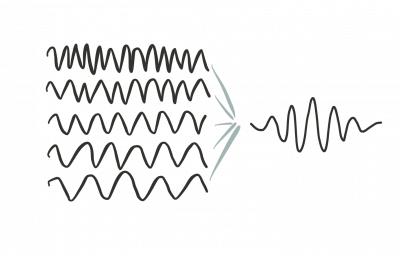
The Fourier transform is a mathematical tool that allows us to split a function into its fundamental constituents.
Concrete
We use the convention common in physics,
The second formula writes as a superposition of plane waves with wave number , and is the amplitude of the wave with wave number . Other books put the factor elsewhere or use in both formulas; results differ by these factors, so always check the convention. For time and frequency one writes in many physics texts, with the opposite sign in the exponent.
Properties. Directly from the definition (integrate by parts, substitute, and assume decays fast enough):
The last line is Parseval's (or Plancherel's) theorem. The first line is the main reason for using the transform: derivatives become multiplication by .
Example: the Gaussian. For we complete the square in the exponent, , and get
The transform of a Gaussian of width is a Gaussian of width . A function that is narrow in is broad in and vice versa. With this is the origin of the position-momentum uncertainty relation in quantum mechanics.
Example: the delta function. The transform of is , and the inversion formula then gives
Example: solving the heat equation. Transforming in gives , an ordinary differential equation for each with solution . Short wavelengths (large ) die out fastest. Transforming back and using the Gaussian result shows that an initial delta function spreads into a Gaussian of width .
In three dimensions one transforms in each coordinate, , and the inverse carries . For a periodic function with period the integral over becomes a sum over , the Fourier series.
- The best short introduction is An Interactive Guide To The Fourier Transform by Kalid Azad and the best longer introduction is the book "Who Is Fourier? A Mathematical Adventure"
- Fourier Analysis by Körner is a good book
- A nice description of how the Fourier transformation is used in quantum mechanics, can be found at page 246ff "The Emperor's New Mind" by R. Penrose.
- No-Nonsense Quantum Mechanics by Jakob Schwichtenberg, appendix "Fourier Transform"
Abstract
Function spaces. The integral defining converges for , and is then continuous and vanishes at infinity (Riemann-Lebesgue lemma). On the Schwartz space of smooth rapidly decreasing functions the transform is a linear bijection, and by duality it extends to a bijection of the space of tempered distributions, which contains , polynomials and plane waves. With the symmetric normalization
preserves the norm on and extends to a unitary operator on (Plancherel theorem). In one dimension , so and the spectrum of is . The Hermite functions , the energy eigenfunctions of the harmonic oscillator, are eigenfunctions with .
Why it works. The plane waves are the joint eigenfunctions of all translations , since . The Fourier transform therefore diagonalizes every translation-invariant linear operator: derivatives, convolutions, and constant-coefficient differential operators. In quantum mechanics the momentum operator generates translations, and the unitary map (with ) takes the position representation to the momentum representation.
Pontryagin duality. The construction works for any locally compact abelian group . Its characters, the continuous homomorphisms , form again a locally compact abelian group , the dual group. With Haar measures on and (suitably normalized) the Fourier transform
is unitary from to , and canonically. The familiar cases are (the Fourier integral), (Fourier series), (discrete-time Fourier transform), and (the discrete Fourier transform used numerically). For compact non-abelian groups such as , the characters are replaced by the irreducible unitary representations, and the Peter-Weyl theorem gives the corresponding expansion of .
Why is it interesting?
The Fourier transform is an essential tool that, for example, makes the music format MP3 possible. With the help of the Fourier transform any given music can be split into the frequencies that it is built of. Then, we can remove those that can't be heard by humans and get an equally sounding, but much smaller music file.
Moreover, the Fourier transform is essential in Quantum Field Theory, where we usually expand any given field configuration in terms of it's Fourier modes and then start analyzing it.
One can Fourier transform anything—often meaningfully.
John Tukey
Path to this page
Leads to: Distributions, Group Velocity, Uncertainty Principle.