
Manifold
Prerequisites: Calculus, Linear Algebra.
- Intuitive What Is A Manifold?
Why is it interesting?
Manifolds are especially important in General Relativity. Through massive objects, spacetime is curved and no longer flat. Manifolds are the correct mathematical tool to describe spacetime when it isn't flat.
Intuitive
The surface of the Earth is curved, but a city map drawn on a flat sheet of paper works perfectly well for finding your way around town. No single flat map can show the whole globe without tearing or overlapping somewhere, so an atlas uses many maps, each covering a region, and neighbouring maps overlap so that we know how to continue from one page to the next. A manifold is any space that can be described like this: every small region looks like a piece of ordinary flat space of some fixed dimension, and the whole space is assembled from such regions glued together along their overlaps.
The surface of a sphere and the surface of a doughnut are two-dimensional manifolds. A figure eight is not a manifold, because near the crossing point it does not look like a piece of a line. The dimension is the number of coordinates needed locally: two for a surface, four for spacetime.
The reason this matters in physics is that calculus only needs local information. Derivatives, velocities and differential equations are defined in small regions, and on a manifold every small region looks flat, so we can do calculus there even if the space as a whole is curved or has a complicated shape. This is exactly what general relativity requires: spacetime is curved by matter, but in a small enough region around any event it looks like the flat spacetime of special relativity. The configuration spaces of mechanical systems are manifolds for the same reason, for example the angle of a pendulum lives on a circle.
Concrete
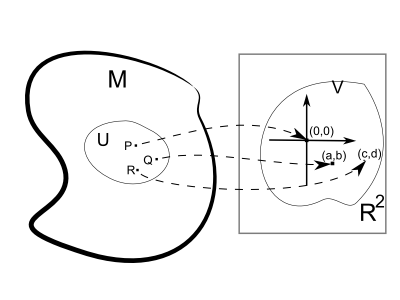
Illustration of the map from some two-dimensional manifold onto . The neighborhood of in is mapped onto in . This map provides a coordinate system in the neighborhood of .
The standard sentence is: A Manifold is a set of points that locally "looks the same" as some Euclidean space. Such geometric spaces are particularly nice to investigate, because we can use, locally, the familiar tools from elementary calculus. Happily, such spaces are not only nice to investigate, but also useful in physics to describe nature.
The idea of locality is made precise by the mathematical concept of a neighborhood. To each point of the manifold, a neighborhood must exist that is just like a small piece of Euclidean space.
The idea of "looks like Euclidean space" is made precise by the concept of a diffeomorphism. If there exists a map from each neighborhood onto some piece of Euclidean space that is smooth, one-to-one, onto, and has a smooth inverse (a diffeomorphism), the space in question is a manifold.
This map from some neighborhood of the manifold onto Euclidean space gives us local coordinates of the points in this neighborhood. The inverse map is called a parametrization of the neighborhood. Therefore another way of thinking about an n-dimensional manifold is that its a set which can be given n independent coordinates ins some neighborhood of any point.
Abstract
A topological manifold of dimension is a Hausdorff, second-countable topological space in which every point has an open neighbourhood homeomorphic to an open subset of . A chart is such a homeomorphism , and an atlas is a family of charts whose domains cover . Where two domains overlap there is a transition map a homeomorphism between open subsets of . If all transition maps are , the atlas is smooth, and a maximal smooth atlas is a smooth structure. A smooth manifold is a topological manifold with a smooth structure. The Hausdorff and second-countability conditions exclude pathological examples such as the line with two origins, and they guarantee partitions of unity, which are used to glue local constructions (metrics, integrals) into global ones.
The point of the smooth structure is that every notion of calculus that is invariant under smooth changes of coordinates can be transferred to . A function is smooth if is smooth for every chart. The tangent space can be defined as the space of derivations of smooth functions at ; in a chart it has the basis , and under a change of coordinates its components transform with the Jacobian of the transition map. The tangent spaces form the tangent bundle , and its dual and tensor powers give covectors, tensor fields and differential forms. Additional structure is put on top of the manifold: a Riemannian or Lorentzian metric for gravity, a symplectic form for Hamiltonian mechanics, a fibre bundle for gauge fields.
Some standard facts: by the Whitney embedding theorem, every smooth -manifold embeds in , so abstract manifolds and submanifolds of Euclidean space are the same class of objects; the abstract definition simply avoids an embedding that has no physical meaning, such as an ambient space for spacetime. A given topological manifold may admit no smooth structure, or several inequivalent ones: Milnor found smooth structures on the topological 7-sphere that are not diffeomorphic to the standard one, and has a unique smooth structure up to diffeomorphism for every , while has uncountably many.
In general relativity spacetime is a four-dimensional smooth manifold with a Lorentzian metric, and the coordinate independence of physical laws is the statement that they are formulated with tensors on . The diffeomorphism group of then acts as the symmetry group relating physically equivalent descriptions.
Examples
The Unit Circle
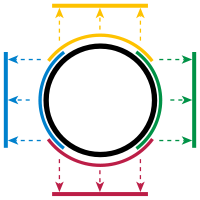
Image by derivative work: Pbroks13 (talk)Circle_with_overlapping_manifold_charts.png: KSmrq (Circle_with_overlapping_manifold_charts.png) [CC-BY-SA-3.0 (http://creativecommons.org/licenses/by-sa/3.0)], via Wikimedia Commons
An example for a manifold is the unit circle , mathematically defined as the set of points fulfilling the condition . This is commomly expressed as:
This manifold is one dimensional, hence the behind the , because two degrees of freedom are reduced to one by the condition . To see that this is a manifold, we need to find a map to each neighborhood onto Euclidean space.
The upper semicircle () is parametrized by . maps the open interval bijectively onto the upper semicircle. The inverse map is smooth and gives us coordinates of the upper semicircle.
For the lower semicircle () a parametrization is . Therefore we have found so far two local parametrizations.
These maps do not cover the points and and we need further maps for the neighborhoods of these points: and . These maps are appropriate for the right- and left-half the circle. Nevertheless they not include and .
We can see that the neighborhoods overlap, which is no problem.
The Two-Sphere
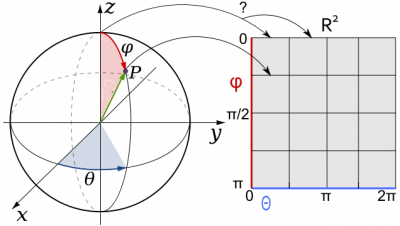
Another example of a manifold is the two-sphere. The two-sphere is defined as the set of points in for which holds, where is, of course, the square of the radius of the sphere. The two-sphere is two-dimensional because the definition involves coordinates and one condition, which eliminates one degree of freedom. Therefore to see that the sphere is a manifold we need a map onto . This map is given by the usual spherical coordinates. Almost all points on the surface of the sphere can be identified unambiguously with a coordinate combination of the form . Almost all! Where is the pole mapped to? There is no one-to-one identification possible because the pole is mapped to a whole line, as indicated in the image.Therefore this map does not work for the complete sphere and we need another map in the neighborhood of the pole to describe things there. A similar problem appears for the map on the semicircle . Each point can be mapped to in the to and , which is again not a one-to-one map. This illustrates the fact that for manifolds there is in general not one coordinate system for all points of the manifold, only local coordinates, which are valid in some neighborhood. This is no problem because a manifold is defined to look locally like .
The spherical coordinate map is only valid in the open neighborhood and we need a second map to cover the whole sphere. We can use for example a second spherical coordinate system with a different orientation, such that the problematic poles lie at different points for this map and no longer at . With this second map, every point of the sphere has a map onto and the two-sphere can be seen to be a manifold.
Another trivial example for a manifold is of course .
Leads to: Curvature, Differential Forms, Differential Geometry, Fiber Bundles, Levi-Civita Connection, Morse Theory, Parallel Transport.