
Local Symmetry
Prerequisites: Symmetry. Full path (3 pages)
Intuitive
A prototypical example of a system with local symmetry is a grid of completely black balls.
TODO IMAGE GRID OF BILLARD BALLS.
We can rotate each ball individually and no observer could tell the difference. Hence this system has a local rotational symmetry.
The symmetry vanishes as soon as we put a little red dot onto each ball. Now it's easy to keep track of the orientation of each ball and there is no longer any local symmetry.
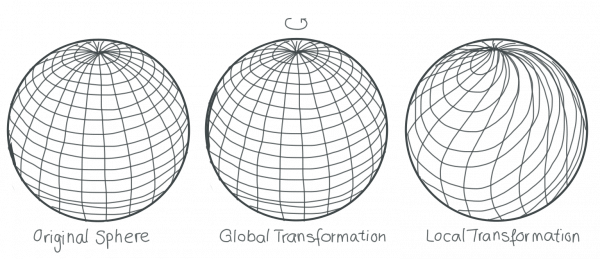
Concrete
A local symmetry is a transformation whose parameters may be chosen independently at every spacetime point. For a Dirac field, compare the global phase transformation with constant and the local one The free Lagrangian is invariant under the global transformation, but not under the local one, because the derivative also acts on : To restore invariance we introduce a vector field and the covariant derivative Then , so is invariant. The field strength is unchanged by , since partial derivatives commute, and is the invariant kinetic term. The result is the Lagrangian of quantum electrodynamics. The sign in is a convention and differs between textbooks.
For a non-abelian group, is a multiplet and with . With and the gauge field must transform as and the field strength transforms as , so that is invariant.
Two configurations related by a local transformation describe the same physical state. Applied to a local symmetry, Noether's first theorem gives a current that on shell equals the divergence of an antisymmetric tensor, in electrodynamics, so its charge is a surface integral at infinity and the theorem gives no conservation law beyond the one of the global subgroup. In addition, Noether's second theorem says that the equations of motion are not independent. In electrodynamics the identity forces the source of Maxwell's equations to be a conserved current. More details are on the page on gauge symmetry.
Abstract
Let be a principal -bundle over spacetime. The group of local symmetries is the gauge group the automorphisms of that cover the identity on . It is isomorphic to the space of sections of the bundle associated to by the conjugation action, and locally it is the group of maps with pointwise multiplication. Its Lie algebra is the space of sections of the adjoint bundle . So is infinite-dimensional, while a global symmetry group is finite-dimensional.
acts on the space of connections on . In a local trivialization, with a -valued connection form and , the action reads in the mathematicians' convention with anti-Hermitian ; the physicists' from the Concrete layer differs by a factor of , and there corresponds to here. Matter fields are sections of associated vector bundles and transform pointwise in the representation . A gauge-invariant action is a functional on that is constant on -orbits, and the physical configuration space is the quotient by . Because does not act freely on in general (reducible connections have larger stabilizers), the quotient is not a manifold everywhere, and a global section of , a global gauge fixing, does not exist in general (the Gribov problem).
In the Hamiltonian formulation the generators of are first-class constraints, the Gauss law for each component of . Physical states are required to be annihilated by the generators of gauge transformations that approach the identity at spatial infinity. Transformations that approach a constant element of at infinity are not removed in this way, and they act as the global symmetry whose charges, such as the electric charge, are measured by flux integrals at infinity.