
Michelson-Morley Experiment
Prerequisites: Special Relativity. Full path (6 pages)
Intuitive
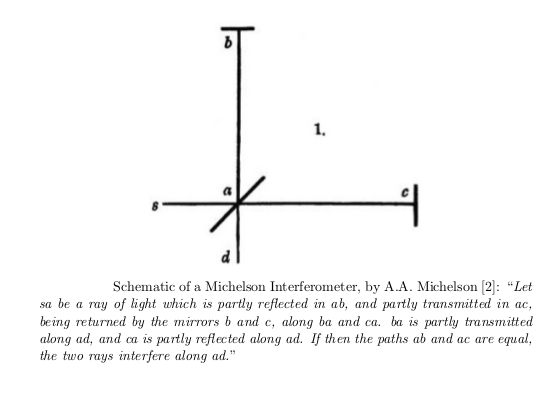
Source: A Michelson-Morley resonant cavity test of Lorentz invariance by Stephen Parker
Concrete
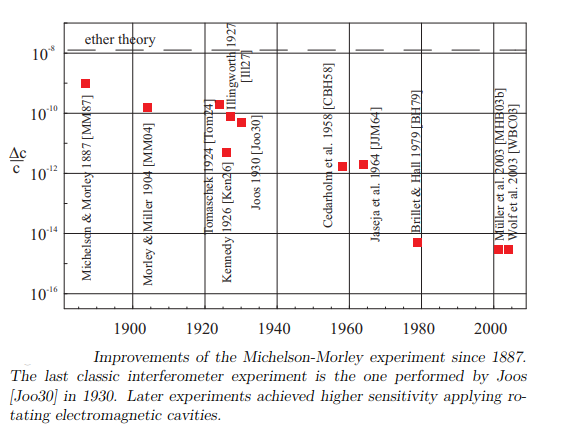
Abstract
A Michelson interferometer compares round-trip travel times of light along two arms, so it is sensitive only to the two-way speed of light. The one-way speed depends on how distant clocks are synchronized and is not measured. The modern way to state what the experiment tests is through a test theory that contains special relativity as one point in a parameter space.
In the Robertson-Mansouri-Sexl framework one assumes a preferred frame with coordinates in which light propagates isotropically with speed , and a laboratory frame with coordinates moving with velocity relative to . The most general linear transformation consistent with rotational symmetry about is written as
where describes the rate of moving clocks, and the lengths of moving rods along and perpendicular to , and encodes the clock synchronization convention in . Special relativity corresponds to , , . The Galilean transformation corresponds to . To second order one writes
so that special relativity has , , . The two-way speed of light in along a direction at angle to then becomes
For the Galilean values this reproduces the ether prediction: along and across it. For an interferometer with equal arms of length , rotating the apparatus by shifts the pattern by
fringes, which gives the classical for the Galilean case. The null result of the Michelson-Morley experiment and its modern versions with optical resonators therefore constrains the combination , that is, the anisotropy of the two-way speed of light. It says nothing about the other two parameters. The Kennedy-Thorndike experiment (unequal arms, looking for a dependence on ) constrains , and Ives-Stilwell type experiments (Doppler shift of moving clocks) constrain . Only all three together fix the transformation to be the Lorentz transformation, which shows that the Michelson-Morley result alone does not single out special relativity. Historically, the contraction of the arm along by the factor proposed by FitzGerald and Lorentz (which sets while keeping a preferred frame) was the first explanation of the null result.
In a field theory language, the same tests are described in the Standard-Model Extension, where Lorentz violation in the photon sector appears as constant background tensors coupled to . Rotating cavity experiments, the descendants of the Michelson-Morley experiment, bound some of these coefficients.
Why is it interesting?
The Michelson-Morley experiment found that the round-trip speed of light is the same in all directions, with no sign of the Earth's motion through an ether. This was one of the results that led to the insight that Newtonian mechanics must be replaced with special relativity.